I made the best game I’ve ever made, and it comes out in a month. It’s been anywhere between two and sixteen years in the making.
Here’s how I made Nildigo.
Voltorb Flip & Gambler Grid
In 2010, I had just got back into playing games on my DS after a good half a decade of dormancy. After Grand Theft Auto: Chinatown Wars and the first two Professor Layton games, I revisited Pokémon, a series I (briefly) lapsed on during its fourth generation.
I got two(?) gyms into SoulSilver when I stepped into what used to be Goldenrod’s casino, to be greeted with its non-gambling replacement: Voltorb Flip. I’ve never had a tiny fraction of a minigame captivate me more intensely than that. I did not leave Goldenrod for real-life weeks; I played Voltorb Flip enough to max out the coin case several times over, even with buying every Pokémon available with the coins.
Just one month after SoulSilver’s initial release, I was brainstorming ways of translating the ideas of Voltorb Flip to my own game.
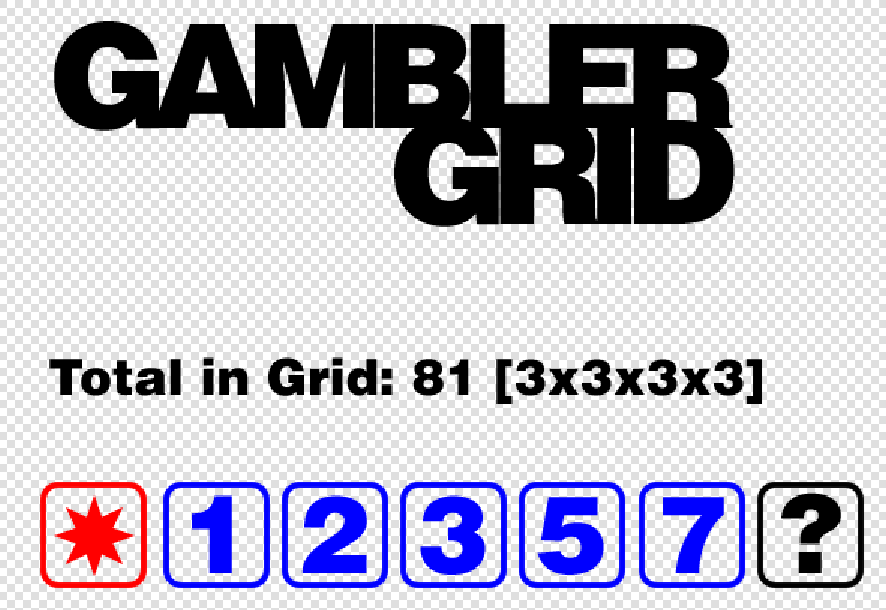
Initial concept art
This is a piece of concept art from the 5th of April 2010. My initial idea, to differentiate this game from Voltorb Flip, was to make all the multiplication values prime numbers to create fully solvable grids.
Nils/bombs/zeroes were not to be factored into those results.
That concept art was to make the game a very stylistically minimalist game.
Mechanics & testing
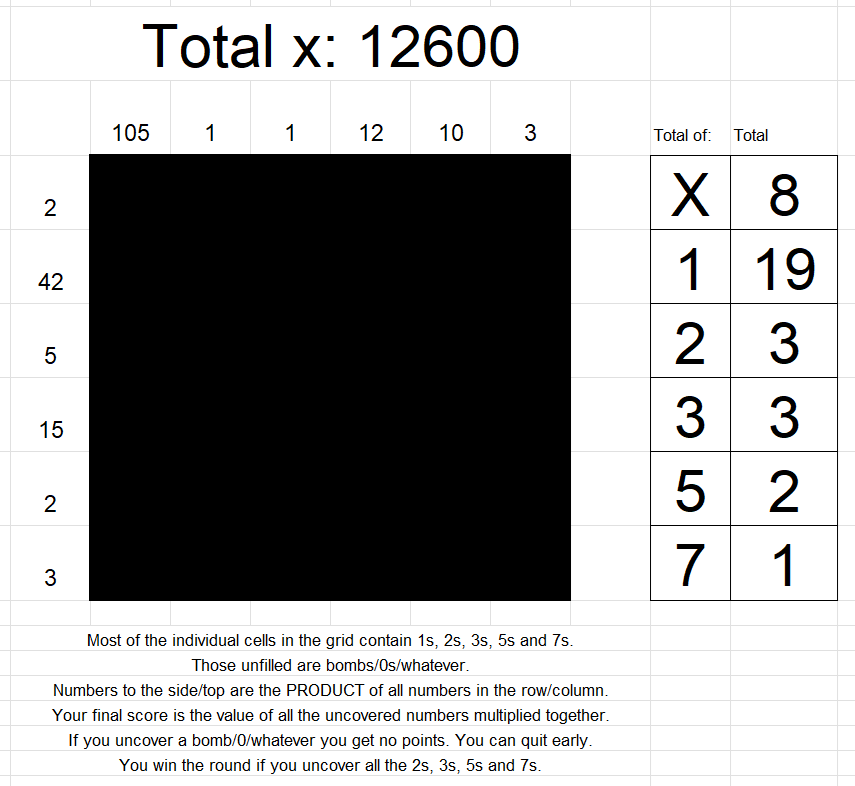
I did not make early tests of the game in GameMaker, instead using Microsoft Excel to test the idea with a sample grid. This is that test, also from 2010, showing the margins reduced from Voltorb Flip’s separated value counts and Voltorb counts to just the products of the non-zero cells.
When I began work on Nildigo, I did briefly try this, but I wasn’t a fan of how the products have to exclude the zeroes to mathematically work.
One thing that I did keep from Voltorb Flip, and that remains in Nildigo, is that 1s are not mandatory to solve the grid.
While Gambler/Gambling Grid went no further than this for a long time, Voltorb Flip and the overarching idea lived rent-free in my head for over a decade. I kept going back to the first 15% of HGSS to play Voltorb Flip. I got into Picross/nonogram puzzles, which strengthened my love of that kind of puzzle. I also kept Minesweeper around, another long-term love of mine. Grids of information are my jam.
The enabling
I’ve spoken at great length about how the end of 2024 was a life-changer in terms of business. Chequered Ink saw a giant uptick in business that effectively saved us, thanks to our collective font output and Daniel’s business masterstrokes.
I spent 2024 making Monoquous 2, a game that let me nostalgically reminisce on the old YoYo Games Sandbox and my Innoquous series that got me my “break” in indie game development. As that game, a pure for-me affair, released to minimal fanfare but maximal self-enjoyment, I was working on “Chequered Ink X”, a compilation of Chequered Ink’s free output to celebrate its first 10 years (which we reached in 2025). Chequered Ink X was a time-sink and a gamble, and I fell out of love with making it as technical issues piled up. (The eventual solution: we released a gigantic Free Games Pack for free instead, with the games unmodified and zipped up.)
During this time, I was also starting to fall in love with uber-casual roguelite games, most notably “Luck Be a Landlord”. I loved that so much, I 100%ed it once on PC, then downloaded it to my phone and 100%ed it again. And then I got a new phone, and 100%ed it again. The new phone was not just for the game, promise.
When we became somewhat financially free to pursue other stuff, I started work on a pet project: Gambler Grid. Except with the gameplay loop of those roguelite games. This did two things: incentivise me to work on something on my to-make list, and to stop getting addicted to roguelites. That way, I couldn’t accidentally lift any more wholesale mechanics. I credit Balatro as inspiration for Nildigo; I plan on finally buying it once my game is out. I’ve seen it on YouTube, I’ve yet to actually play it.
Week 1
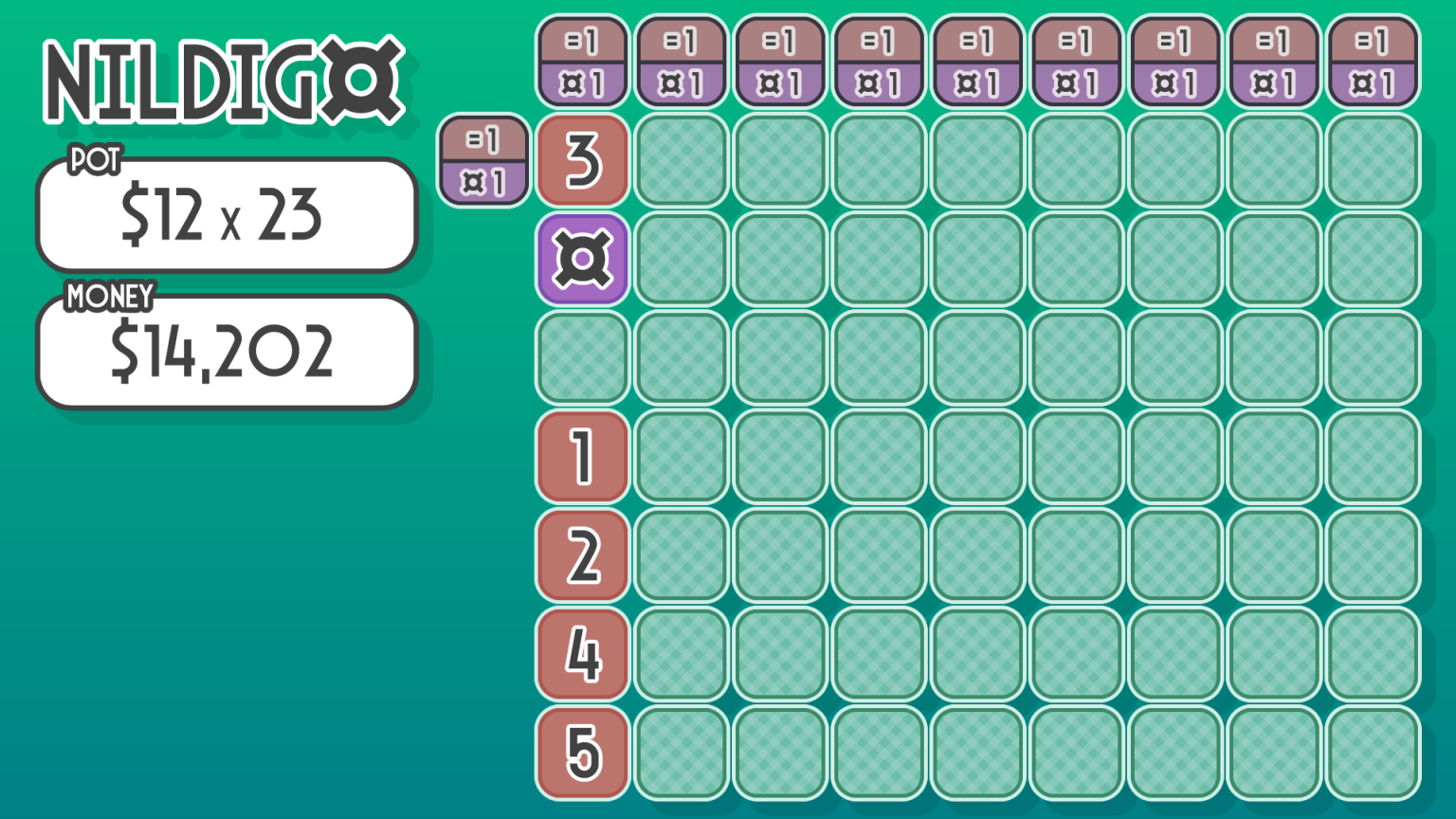
“oh I should mention btw, I got semi distracted, I'm making a small game that will either be free or very cheap. I definitely need to can some of the wiki/library plans for Chequered Ink X, it's boring as fuck to make and nobody is going to care. but yeah I'm making a small Voltorb Flip Balatro thing real quick to satisfy a big roguelite gamba kick I have rn and I wanna capitalise on the creativity instead of slogging on the CIX minutiae” - me to Daniel, on January 15th 2025
The screenshot above shows the first piece of concept art I made for Nildigo, mid-January 2025, before I started the actual project in GameMaker. Benefits of being a professional graphic designer: no placeholder art for me! Quite a lot of the elements this early remain in the final game, although a lot has changed, perhaps most notably, what the Nils look like - I originally used the currency symbol for them (as a simplified “mine” icon), but a friend, Lena, suggested that since it is a currency symbol, it’s misleading. I ruminated on that feedback, and added a “No” symbol to my Arcane Nine font to replace it. A couple of the early pieces of Perk art still contain the old icon. Partly a throwback, partly I never got around to updating them.
A lot of the core mechanics of Nildigo came to me all in a condensed blast of inspiration while I made the initial concept art, largely thanks to Voltorb Flip and Balatro. I reverted to the Voltorb Flip way of scoring 2 and above, making them multipliers for the “payout”. The presentation of Balatro completed the puzzle - separate the “Pot” into base money + multipliers, and make 1 add to the base value. Zeroes are also multipliers, which zero out the entire Pot and act as the lose condition (since once the multiplier is zero, you can no longer make money on the board.)
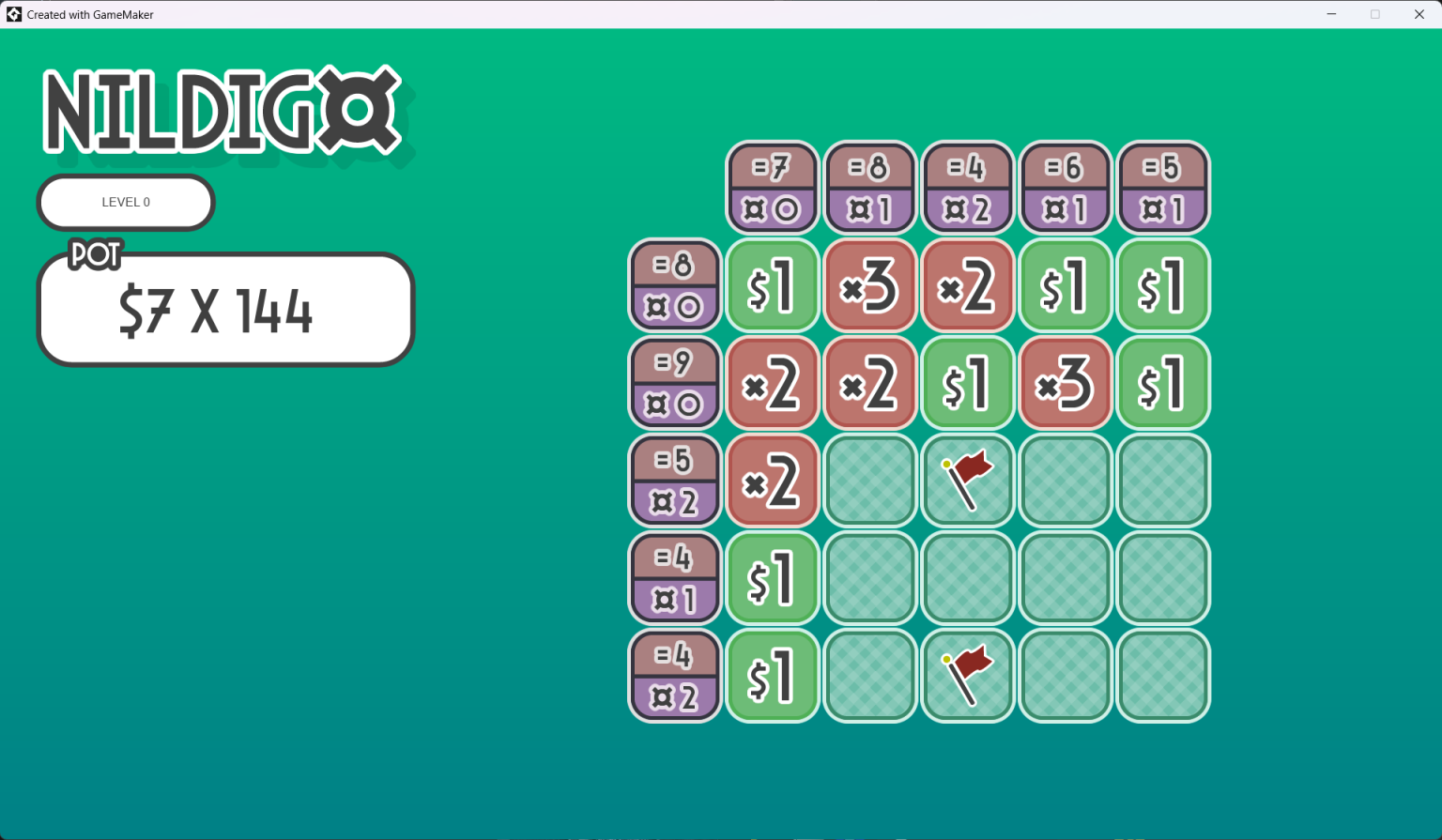
This is the earliest image I have of the game actually working, and was the SAME DAY as the image above. I got very hyper-focused on Nildigo very quickly.
As I had all the realisations of the game’s core mechanics all at once, I updated bits of the art. Start each board on $0×1, $1s are additive, everything else multiplicative. Clarify that in the art; $1s are green, multipliers red. The initial boards were all 5×5, as with Voltorb Flip, but I’d programmed the game from the get-go to easily support other sizes. Everything I added to this game, I made as expandable as possible; this was very well-intentioned, although with hindsight, a lot could be done differently. I had no idea how far Nildigo was going to go, it was still a pet project this early on.
Programming the basics gave me time to stew, and the ideas the breathing space to cook. Since the game was a roguelite, I didn’t want boards to always be guaranteed solvable, but I also didn’t want to leave it frustrating. The first solution to this was to add “Powers”, expendable items which helped disambiguate boards. All of the Powers were settled on within one more day of making Nildigo. (It is probably worth noting that I spent like 15 hours a day making Nildigo in its early stages. I was enamoured with it.)
Sweepers were the simplest and first Power I conceptualised, which literally just safely solve one cell (negating/”defusing” a Nil).
Second were Scanners, which turned a tile into a Minesweeper cell (counting the Nils in the 8 squares around it); these were initially very powerful and usable on any cell at all. For balance, I limited their use to revealed $1s, which also created an extra incentive for hunting down the otherwise-optional $1 cells.
The other Powers came from wanting the game to allow increasingly-skyrocketing payouts (Buffers, which add to the effect of Multipliers), more condensed information finding (Filters, which scan a 2×2 area and display a count of each type of cell), sweeping row/column information (Headmasters, which fully reveal an entire line of cells), and one to reveal all the optional $1s at once to maximise a board’s payout (Scavengers). I liked the idea of almost every Power affecting a different area; it posed a bit of a challenge with programming efficiently, but felt more satisfying and already created some emergent combinations I hadn’t anticipated.
Some of the Powers were revised in the art department based on my own experience. Scanners were most dramatic - originally they fully replaced the $1 cells with a Minesweeper-esque readout, but I found that I IMMEDIATELY started misreading all the other cells as readouts and making errors. I tweaked it quite a few more times before finalising how they looked.

The history of Scanner output, showing 2 Nils in all instances surrounding a $1 cell.
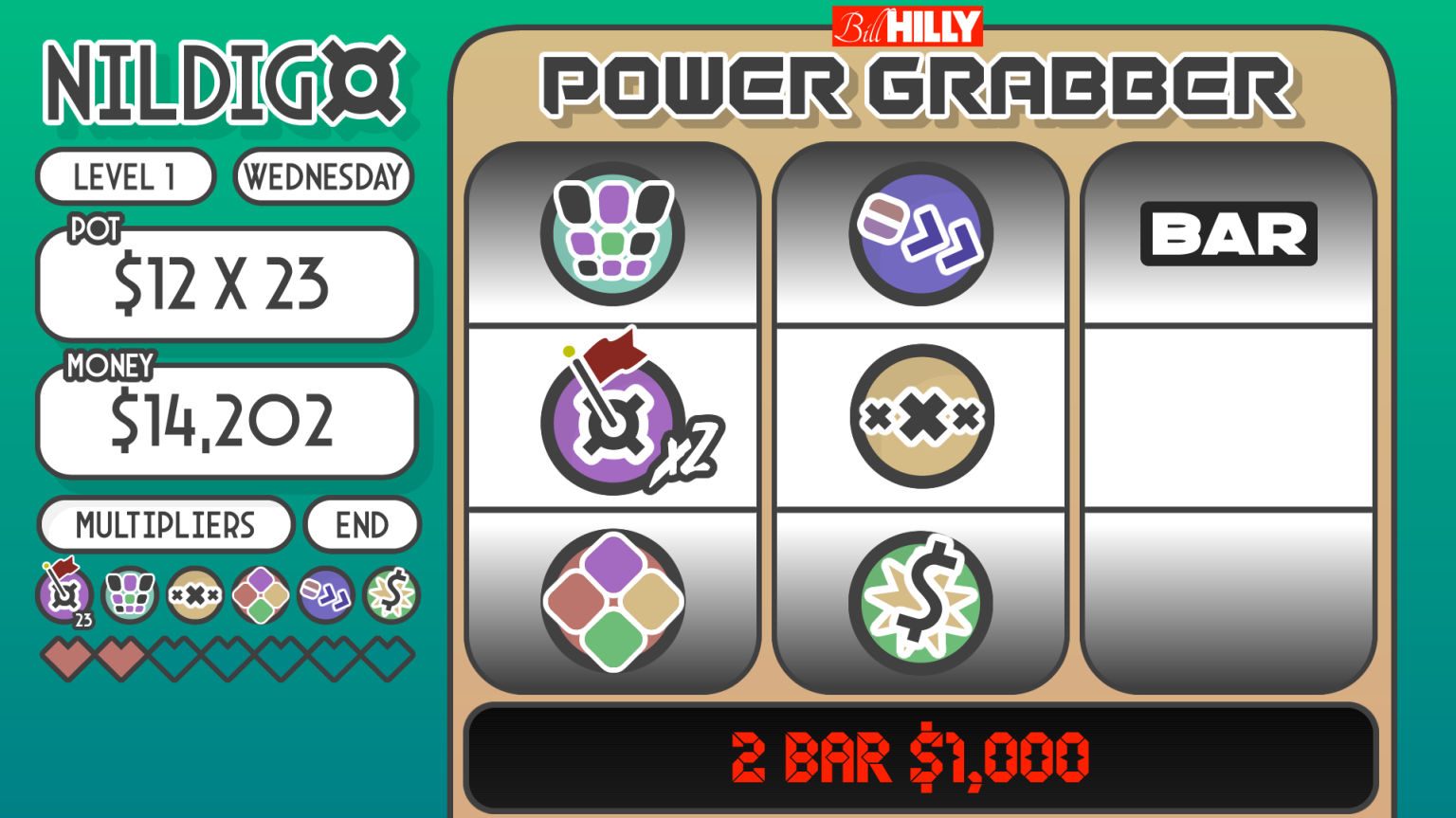
An idea I wanted to do for a while was interstitial fully-simulated fake gambling; I explored this a little in Basically Capitalism and Courier 66, but Nildigo provided the best possible outlet for it - giving players, between boards, a couple of extra Powers without letting them choose which ones they got, forcing them to use them all to their best effect as runs went on. The Power Grabber was born.
I’m a sucker for maintaining scraps of canon between my games; “Bill Hilly” is the casino you can visit in Courier 66.
I found in early testing that the Power Grabber gave slightly too many Powers, making the game fairly trivial to play forever. BAR fixed this, by reducing the output while instead providing a jackpot possibility. I was also workshopping what eventually became Perks, which would replace some of the Power Grabbers with something else.
Before Perks were implemented, I tried some different timings of when Power Grabber would be skipped in preparation, and a very convenient idea worked perfectly - make Nildigo operate on a week cycle, with weekdays (Mon-Fri) as the Power Grabber days.
Perks
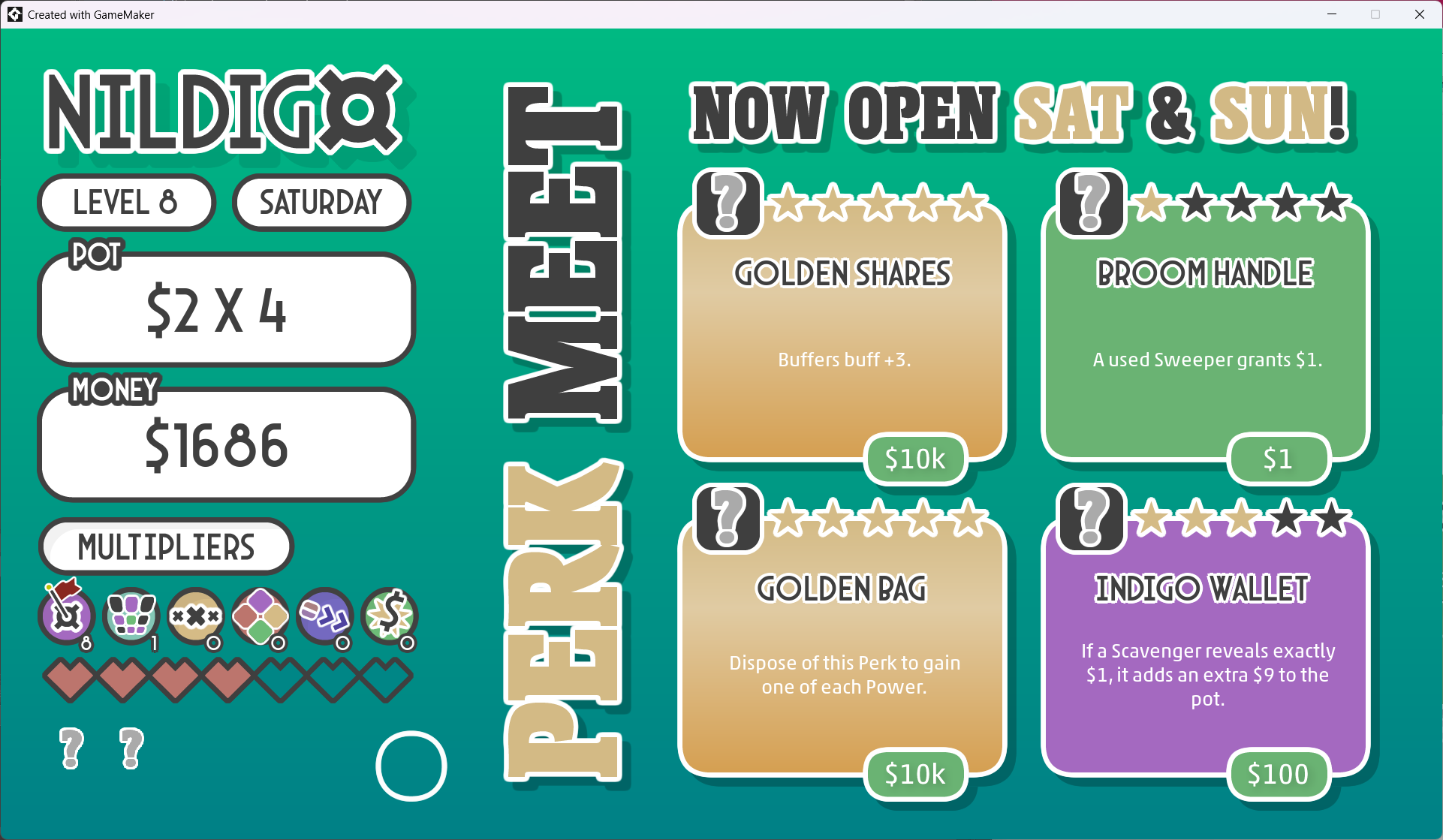
My first idea for giving players Perks was a Roulette wheel; I didn’t feel that it provided enough choice to effectively “deck-build”. Then, I had a very silly idea, inspired by their weekend appearances - base it on old British car boot sales. I used to trawl the once-local Banham Car Boot sale on Sundays. I have blogged in the distant past about my Banham hauls.
Perks started slow; I initially did not do the art pass, I wanted to get the programming side right first and foremost. This is a rarity for my usual workflow. I added the base work - an expandable library in-game of the Perks, and a few scripts I could use to “call” Perks when owned and when their activation was relevant.
Most of the early Perks involved adjusting/buffing the functionality of Powers, preserving lives, and increasing general money output. I kept the Perk count reasonable at first, anticipating inspiration and ideas to be generated naturally as the game was developed - the right call in the long run. Most of the best Perks appeared in the last year to properly “finish” the game off.
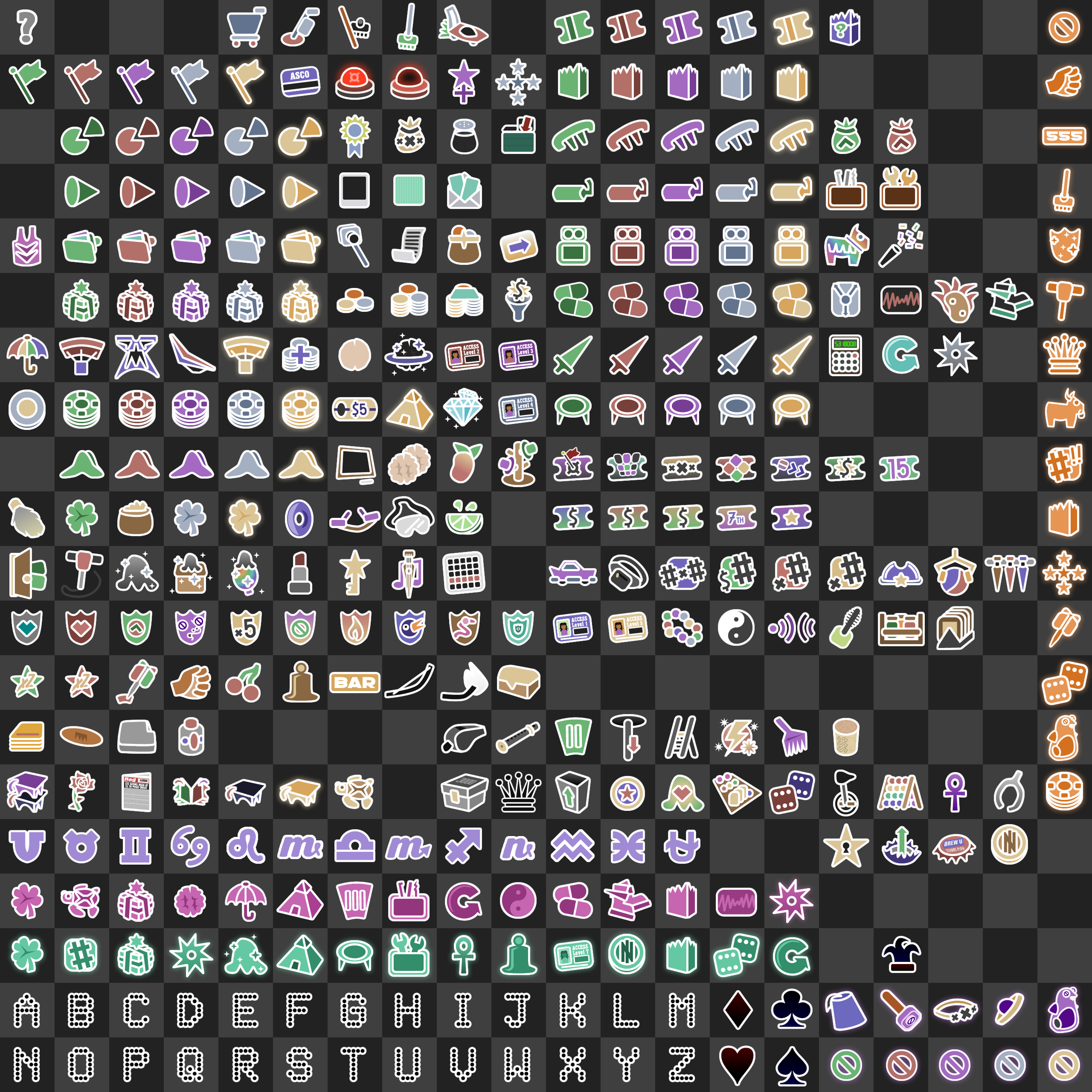
Perk art was a grind. Adobe Fireworks is my weapon of choice for graphic design, has been for over 20 years. I gave myself almost the biggest canvas Fireworks allows before it gets picky and weird about it, and gridded off the background to my intended art size.
I’m still not sure why I landed on the white outlines, but I like the result. Forced me to think a little differently to normal.
By the end of the game’s development I had nearly filled up the master image; 333 Perks total in a 20×20 grid. Were I to point out every point of inspiration for some of these, this blog would be even longer than it’s gonna be, but I’ll point out some of my favourites:
“Distracting Lime” was my friend Dan Rudge asking me to add a lime as a Perk
“Loggerhead” is from the perpendicular row/column it reveals being “at loggerheads” with the one you chose. The turtle’s name is Borkous Benjamin as a reference to DankPods + “Benjamin” alliterating cleanly
“Door Money” is from another friend, Matty. I decided one day to put some loose change in his car door. He looked annoyed. So I did it again, to which he screamed “STOP GIVING ME DOOR MONEY” in my face.
Bottlecap has the “Brew U” logo on it; Brew U is a fake drinks brand I invented for Four Versus the World
Gossip Column features “The Rag” tabloid newspaper; this has now been in several of my games, originating in Jasmine Laslo - Switch U On and perhaps most notably in Revolver and Co
Victory Bell is based on a card game I made of the same name, which I really, really want to get published or self-publish one day. Maybe if Nildigo does well? A fun aside to this is Victory Bell started life as a silly joke card game called “You Win McGregor”, which my deputy best friend still wishes was its name
Fundamentally, Perks and the Perk Meet went into the game and remained unchanged beyond the expansion of the library, balancing changes (originally you could buy multiple Perks from one Meet; this was so overpowered it became a Constellation Permanent) and the addition of/evolution of Permanents.
Permanents
I quickly wanted an end goal to the game; the big initial idea for this was to include some extremely-expensive ultra-powerful Perks.
I added two types of them; Permanents and Ultra Max Permanents.
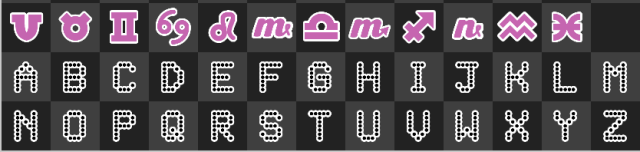
The earliest art of the Permanents I have
I styled the former after astrology and the latter after astronomy; 12 Zodiac signs and 26 constellations, each of the latter represented by a letter of the alphabet. I best chose from the 88 constellations… not every single one works great. (Canis Major as J ugh.) The only rule I gave myself in doing this was to not use any of the constellations that are also Zodiac signs.
The Zodiac signs all give free Powers and lives when beginning runs, and the Constellations are a vast array of overpowered nonsense. I originally had these all appear in the Perk Meet from the start, but it was too easy to find overpowered builds to afford anything from the Perk Meet.
I kept having ideas for more Permanents, but I left no real leeway for adding more, so I added two extra types shortly after. “Charms”, part of the regular Permanents, either acted as dispensers for regular Perks I liked a lot/that had a lot of diverse applications, or often as un-nerfs of overpowered base features. And “Suits”, part of Ultra Max Permanents, gave strong bonuses when you lose lives. Sacking lives deliberately was a mechanic I intended to be a stronger legitimate strategy than ever really comes into play in Nildigo.
As the game developed, Permanents felt archaic and far too easy to collect. My first change was to lock them behind two hurdles; regular Permanents only became available past Level 10, and then “Shamrock Charm” was added as a Permanent that then allowed Ultra Max Permanents to appear.
As the game developed more, this still proved too quick. I slowed it down further; I deprecated the use of “Permanent” and “Ultra Max Permanent” and instead separated Zodiac, Charms, Suits and Constellations into their own distinct class of Permanents. I added “Talismans” as an upgraded class of Charms, with a new teal hue, and recoloured Zodiacs to a lilac shade. Finally, I added new unlock Perks; Level 10 unlocked Zodiac. The new thirteenth Zodiac “Ophiuchus” (based on the kinda-sorta-rejected 13th Zodiac sign) unlocked Charms. Shamrock Charm was adjusted to unlock Suits. The Suits gained Joker, which unlocks Talismans. And, in fitting with the same Charm, Shamrock Talisman seemed fitting to unlock Constellations.
Quite a few of the old Charms became Talismans instead. With a few others, I added Talisman equivalents with a stronger effect than the same Charm, or nerfed the Charm. A few Charms and Talismans are unique and don’t have an equivalent of the other type. Overall, I kept both at 15 total; my lucky number of lucky items.
Two other Perk types, which are sort of Permanents but not marked as such, exist in the game, which are worth going over in the order I conceived them.
Nildigod
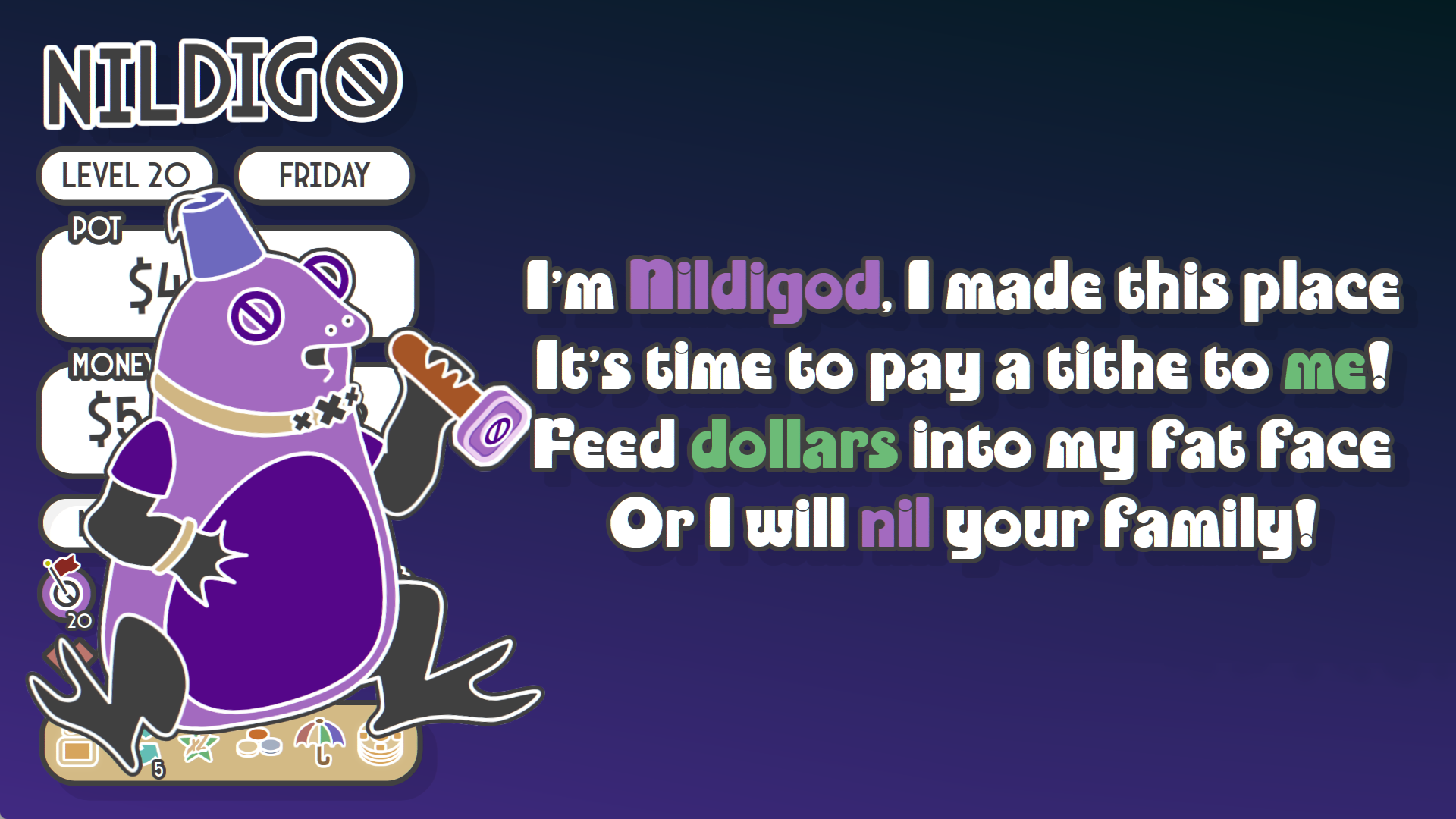
Mid-2025, half a year into the game’s development, I started working out how to properly “roadblock” runs until you could synthesise perfect Perk groups. I came up with the idea of a villain called Nildigod, which originally was to be a menacing entity. This kind of thing never fits my style.
I drew a bunch of designs on paper. (I still have this somewhere, I will edit it in if I can find it). Long story short: my original plan was for Nildigod to be an aethereal ball of gas, a plan which got rudely interrupted when I jokingly drew a slightly goofy off-brand Charmander with Nils for eyes, laughed, and realised I’d permanently consigned the character to a goofy joke. No regrets, eh.
Nildigod being silly set the tone for the game, and allowed me to play into my strengths when writing them. I got to incorporate comedic poetry, as I often do with my games. Nildigod’s entire lore built the story of the game; the whole thing is orchestrated by effectively a massive toddler in a suit menacing only to them. I think part of this was my childhood love of being the “host” of things, particularly quizzes and puzzles. Aside from Charmander, the design of Nildigod was inspired by Mr Blobby and Moneybags from Spyro the Dragon (Spyro 2 was also the inspiration for Talismans). I gave Nildigod a blue fez to reference the three times I’ve managed to end up as the good Al-Hadikhia in Blood on the Clocktower. If you know the game, you know that’s weird.
I sort of guessed the pacing of the game when I first implemented Nildigod and happened upon what I think is the right answer first time. Nildigod shows up every 10 levels, up to level 100, dispensing a powerful Permanent Perk (called a “Piece of Nildigod” in the game).
A big thing I wanted to do with Nildigod, that I seldom see in similarly-paced roguelites, was to permanently remove each Nildigod encounter once you’ve beaten it once, allowing future runs to get further without the Power drain Nildigod generally causes. (You do not get any Perk Meets or Power Grabbers for the duration of Nildigod tithes.)
Balancing Nildigod was tough, and is borderline impossible to get perfect; some Perk builds are naturally going to absolutely wipe Nildigod’s tithe, others will struggle and end up borderline softlocked, never making enough. That’s something I think is okay. My intent from very early was for the endgame of Nildigo to be overpowered nonsense; the final game is breakable and I invite anyone playing it to break it.
At the point I implemented Nildigod, I had only properly balanced the game up to Level 50. The first five Pieces of Nildigod being parts of their main costume reflect that. Later, as I had the game balanced up to Level 100, I ensured the effects of the five coloured Nil Pieces of Nildigod worked too.
It’s a little silly that the Indigo Nil, both parts of the game’s name, is the Level 80 power, not the Level 100 one. But hey.
Starter Perks
Into 2026, the thing I felt the game was missing the most was the starting character/effect thing a lot of roguelites do, but I wanted to go a little unique and keep it feeling Nildigo-ey. I landed on making a final type of Perk, “Starter Perks”.
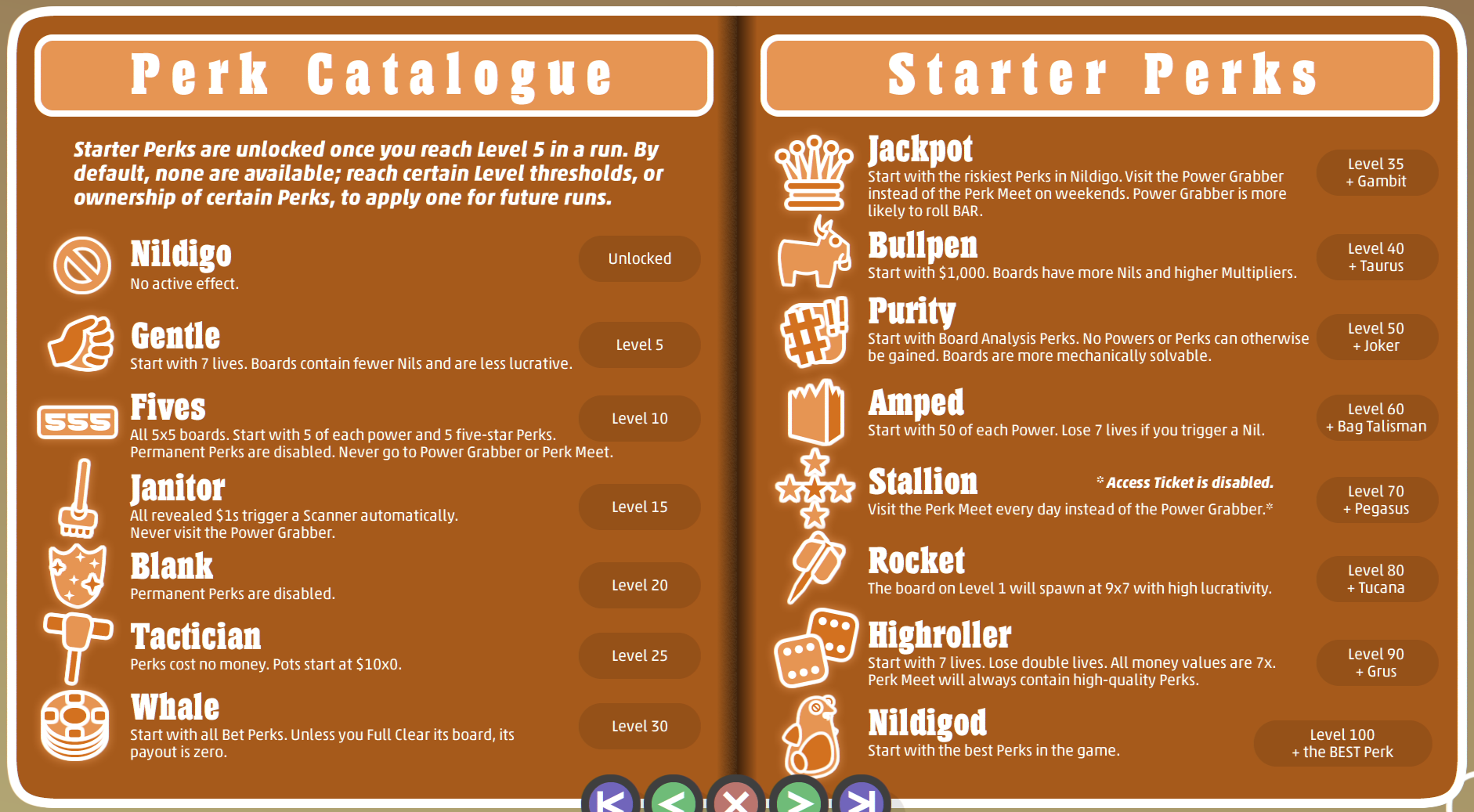
Unlocked with certain progress milestones, I used Starter Perks in a similar way to Charms and Talismans: allowing certain Perk synergies to thrive in a way that could be guaranteed every run. I’ve already said “emergent” in this blog post once but it’s genuinely part of what makes Nildigo my best game of all time: a lot of what makes the game magic, I did not consciously create.
Starter Perks also went a long way to addressing the concerns and wishes of players. For example: solvability. I had not anticipated quite how important guaranteed solvability would be to a lot of people interested in Nildigo: so I found ways to add it. Gentle and Purity both guarantee it, and that’s all thanks to an “ambiguity-removing” Perk I added within the final 10 Perks I added to Nildigo.

Musical Tie is the best Perk in the game, out of all of them, including the Constellations. I should have weakened it… but it would have made the game less fun.
The last mechanical change I made to Nildigo - literally this week - was to apply the effects of Musical Tie to Gentle. You can now guarantee solvable Nildigo once you’ve had a run go to Level 5 once. (You won’t likely make it past Nildigod encounters on Gentle, but you can still play runs endlessly with full solvability this way.)
This is one of the probably 30+ individual revelations I’ve had along the way of making Nildigo, and is part of why I’m so proud of it.
The Magazine
Nildigo is the first game that let me dust off one of my other other talents of yore: magazine design. In the late 2000s, I contributed to a GameMaker-focused online magazine called GMTech, first as a spellchecker and later as a reviewer, going on to write the front page reviews with interviews and developer discussions for a game or two (including one by Vertigo Games, who went on to create Cook, Serve, Delicious!). Into the start of 2010, I made a few issues of my own magazine, RekameMag.
This is to say: Nildigo features a 90-page magazine (the “Help Guide”) detailing every facet of the game in detail, with a Perk catalogue inspired by those of Argos and Index, and several fake adverts and lore building for the Perk Meet etc. Nildigod has vandalised it several times.
It’s one of those parts of the game that is wholly unnecessary, and won’t be interesting to most people who play the game, but it’s me, and it’s fairly unique to Nildigo among its similar peers. That also contributes to why I’m so proud of Nildigo - it’s the greatest, most condensed collection of my artistic flourishes, on top of being the most fun game I’ve ever made.
The Rest
There’s stat tracking, hundreds of in-game achievements (separate to the 35 Steam achievements, a nod to my age at time of game’s release), a bunch of options, and a Perkdex that tracks the total seen & owned Perks throughout the game, for completionists.
The game stores key moments in each run and you can pore through them on the Game Over screen, which also provides a number of key hints to information that otherwise would have to be discovered naturally (or found in the Help Guide), such as when each Multiplier starts naturally occurring on boards, when the boards increase in size, or specifics to the deliberately-vague wording on some Perks.
The Key Details
Nildigo will retail at $10.99 (US price; £8.99; €10.49) on Steam and Itch.io. It will have a 20% introductory sale on both.
Nildigo releases on 11th December 2026 for PC.
Nildigo will release on Nintendo Switch in 2027. Other platforms are pending the game’s success.
There is a demo on Steam; almost every facet of the game internally has been tweaked since it, but it does represent the final game decently.
The price point was a lengthy discussion between me and Daniel - the verdict was, the game is worth more; we did not want to charge too much for it.
Estimated time to complete the game the first time is around 10-20 hours, depending on luck and willingness to deploy some mathematics. 100% Steam Achievements is probably closer to 30 hours; 100% on the in-game achievements would take ages but by all means go wild.
You do not NEED maths to enjoy the game. It will be slower, but you can absolutely gamble it out. You’ll eventually find Perks that minimise the need for thought.
Nildigo is mechanically solvable by acquiring Musical Tie or through the Gentle and Purity Starter Perks.
You can also remove the need for guesswork in several other ways, such as stacking Power-farming Perks, or having Power effects trigger automatically (eg with Janitor).
Nildigo is made with zero AI. All art was created by me in a program that Adobe shot and killed in 2012. Still mad about it. All music is licensed from GameDevMarket. All programming was done by my own two hands and 23 years of experience with GameMaker.
If Nildigo does well: I have a ton of plans for updates. They will be free as long as it’s possible and sensible. I’ve got a whole Excel sheet of unimplemented Perk ideas and major gameplay shifts for beyond Level 100. I have ideas for side-modes.
Nonetheless: Nildigo 1.0 is a complete, polished game.
Final words
I’m going to talk about Nildigo a lot going forward. I’m really sorry about that. If the game’s of no interest to you, I’m especially sorry.
But if it does interest you? Please consider grabbing it when it releases. I swear - if it looks fun to you, you will probably enjoy it a lot. It has hooked several of my friends into 20+ hour playtimes. They never did that for any of my previous games.
I originally made Nildigo with the intent of shipping it to publishers. In the end, I’m seriously glad that it’s Chequered Ink’s to self-publish - I have fallen in love with it. It’s my absolute baby. I’ve made over 200 games in a quarter century of making them, and this is so distantly my greatest work to date that I’m scared to start another project.
Wishlist Nildigo on Steam
